Discoveries
Beneath the Flying Saucer: How Project Mogul Confounded Roswell
For decades, an isolated New Mexico ranch stood as the epicentre of extraterrestrial mythology. Declassified records confirm that the military debris recovered in 1947 belonged to an audacious, top-secret acoustic espionage operation.
27 October 2026 · InMillhouse
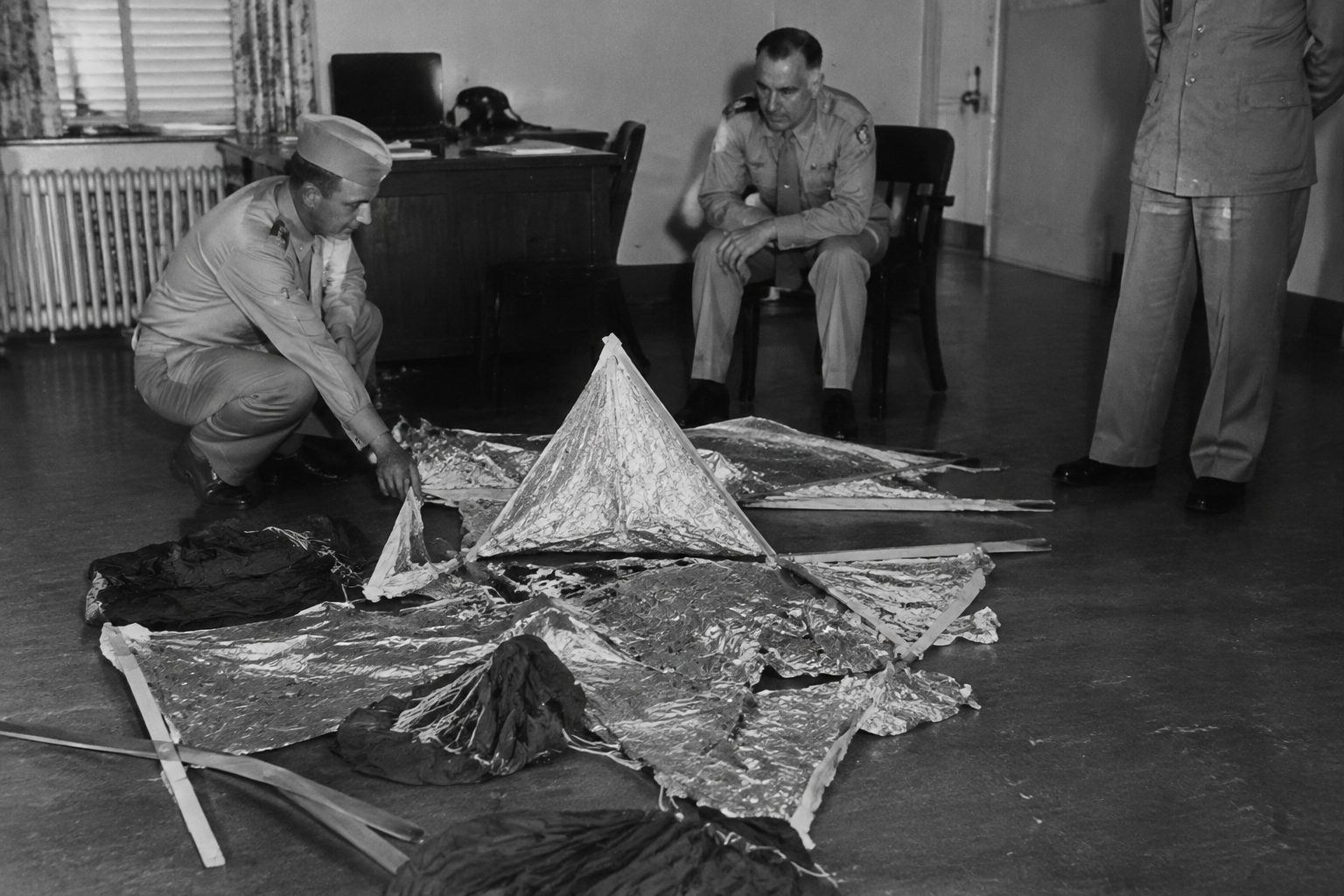
In early July 1947, rancher Mac Brazel discovered an anomalous scatter of metallic foil, lightweight sticks, and tough parchment across the desert terrain of Lincoln County, New Mexico. Upon reporting the find, personnel from the Roswell Army Air Field—home to the world's only nuclear-capable bomb group—swiftly retrieved the material. On 8 July, public information officer Walter Haut issued a sensational press release announcing the recovery of a 'flying disc'. Hours later, Brigadier General Roger Ramey displayed portions of the wreckage to reporters in Fort Worth, Texas, identifying the fragments as the mundane remnants of a weather balloon fitted with a radar reflector [1].
This abrupt correction sowed the seeds of a durable conspiracy theory. Over the subsequent four decades, fringe authors and ufologists claimed the initial release represented an accidental disclosure of alien visitation, whilst the weather balloon explanation formed a deliberate military cover-up. Elaborate narratives emerged alleging the recovery of alien cadavers, reverse-engineered technology, and an ongoing shadow administration designated 'Majestic 12' [1].
In July 1994, following a congressional enquiry directed by Congressman Steven Schiff, the Office of the Secretary of the Air Force published a definitive, declassified investigation entitled *The Roswell Report: Fact versus Fiction in the New Mexico Desert*. Cross-referencing contemporary logs and technical manifests, the report established that the debris was not a standard weather balloon, but nor was it extraterrestrial. It belonged to Project Mogul [1], [2].
Conceived by Columbia University geophysicist Maurice Ewing, Project Mogul was a classified, top-tier Manhattan Project successor designed to detect acoustic pressure waves generated by anticipated Soviet nuclear tests. The project deployed long trains of neoprene and polyethylene balloons carrying sensitive microphones, micro-barometers, and radar targets into the upper troposphere's acoustic duct. Records maintained by New York University researchers operating at Alamogordo Army Air Field reveal that Flight 4, launched on 4 June 1947, was never tracked to recovery. Its specialised materials—including balsa wood struts reinforced with adhesive tape bearing purplish floral patterns produced by a domestic novelty manufacturer—matched the exact physical testimonies recorded in 1947 [1], [2].
The Roswell myth persists largely because secrecy generated its own vacuum. Confronted by public curiosity, the United States Air Force elected to suffer the transient embarrassment of a flying saucer misstatement rather than compromise its most sophisticated Cold War monitoring apparatus [1].