Discoveries
Project Sunshine: Declassified Records and the Post-War Strontium-90 Harvest
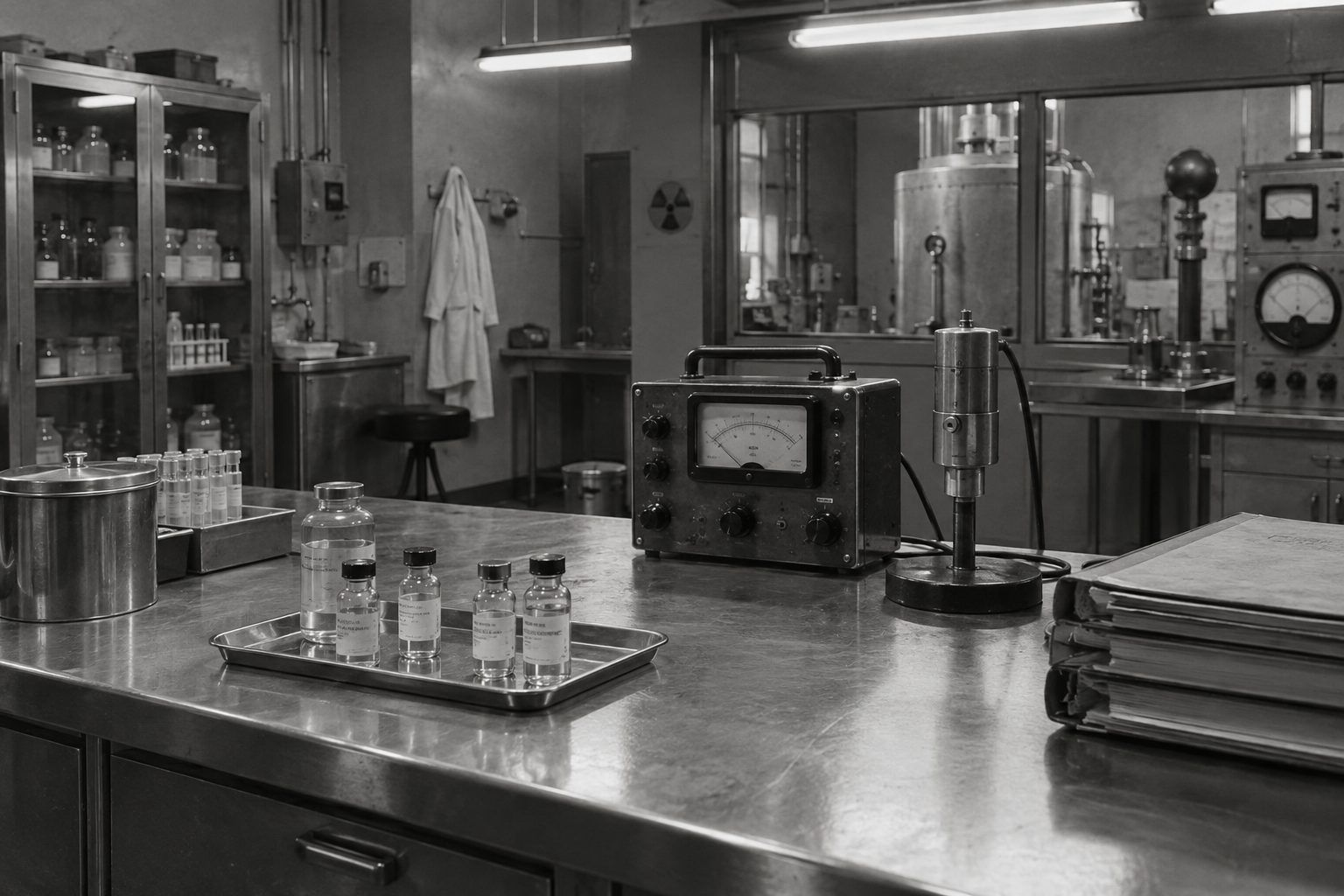
Decades of secrecy fuelled persistent allegations of atomic body snatching. Declassified government archives reveal a bureaucratic programme that was ethically fraught, yet far removed from sensationalist folklore.
25 October 2026 · InMillhouse
In the shadow of early Cold War thermonuclear detonations, rumours long circulated that western intelligence agencies and atomic energy authorities engaged in covert grave-robbing to source human tissue for fallout studies. Sensational accounts alleged shadowy operations spiriting away remains under complete fabrication. However, declassified records—most notably those examined by the 1995 Advisory Committee on Human Radiation Experiments (ACHRE) and preserved within the United States National Archives—reveal a history that is thoroughly documented, rigorously bureaucratic, and ethically problematic [1].
Initiated in 1953 under the auspices of the United States Atomic Energy Commission (AEC) and the RAND Corporation, 'Project Sunshine' sought to measure the global biosorption of Strontium-90, a dangerous, long-lived radioactive isotope liberated by atmospheric nuclear tests [2]. Because Strontium-90 mimics calcium, it accumulates directly in the skeletal matrix. AEC scientists determined that the most reliable metric for assessing global human contamination was to measure bone samples from infants and stillborn children, whose growing skeletons absorbed the isotope at the highest rates.
Popular mythology often depicts clandestine 'body snatching' squads operating illicitly in mortuaries. The historical record indicates a different mechanism. AEC transcripts—including a candid 1955 conference transcript in which biochemist Willard Libby remarked on the urgent need for human tissue specimens—prove that researchers established global, informal networks among medical professionals to procure samples. Hospital pathologists in the United Kingdom, North America, Australia, and Western Europe routinely extracted femur samples from deceased infants during routine autopsies and dispatched them to research laboratories at Columbia University and the University of Chicago [1], [2].
The fundamental ethical violation documented in official findings was not physical grave desecration, but the routine, systemic omission of parental consent. For nearly two decades, grieving families were kept entirely unaware that remains had been partially harvested for military-scientific research. British and American governmental investigations in the 1990s formally acknowledged that post-mortem harvesting had occurred extensively without familial permission, driven by atomic-era expediency and a patronising medical paternalism [1].
Ultimately, declassified archives disentangle hyperbole from administrative reality. Project Sunshine was never an underground body-snatching syndicate; rather, it was a state-sanctioned research endeavour whose lack of transparency, exploitation of deceased infants, and indifference to informed consent exposed the profound moral compromises of early atomic testing [1], [2].