Discoveries
The fungus behind the “zombie ant” nickname
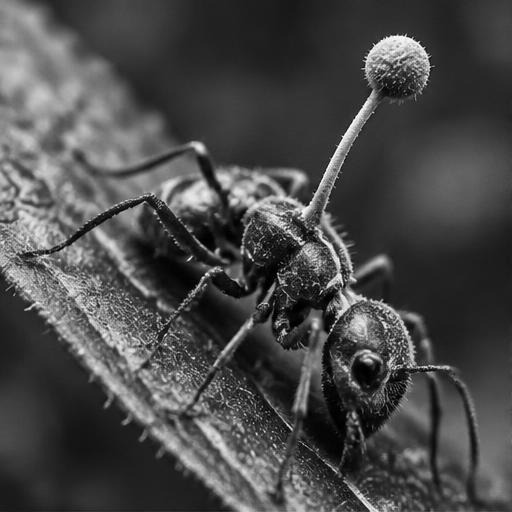
A parasite changes its host’s behaviour, but the mechanism is biology rather than resurrection.
30 October 2026 · InMillhouse
Some carpenter ants infected by fungi in the Ophiocordyceps unilateralis species complex climb vegetation and clamp their jaws onto a leaf or twig. They die there, after which the fungus produces a stalk that releases infectious spores. The position helps the parasite’s reproductive cycle. “Zombie ant” is a memorable nickname for this manipulation, not a claim that dead ants return to life. [1]
A 2017 study led by Penn State researchers added an unexpected detail. Using three-dimensional imaging, the team found fungal cells throughout the host’s body, including cells invading muscle fibres and forming networks around muscles. Yet they did not find the fungus inside the brain at the stage examined, when the ant was fixing itself to vegetation. [1]
That finding does not mean the researchers solved every step of behavioural control. They proposed that the fungal networks might help coordinate effects on the host, while the precise mechanisms remained under investigation. Nor does an ant-specific parasite establish the human zombie scenarios familiar from fiction. The documented phenomenon is narrower and stranger in its own right: one organism can alter another’s behaviour in ways that favour its reproduction, without simply replacing its brain. [1]
Editorial note: This feature summarises the published sources listed below; it is not a new archive investigation. The accompanying image is AI-generated illustration, not an archival photograph or evidence of the event.