Discoveries
The 'Heart Attack Gun': Separating Church Committee Fact from Folklore
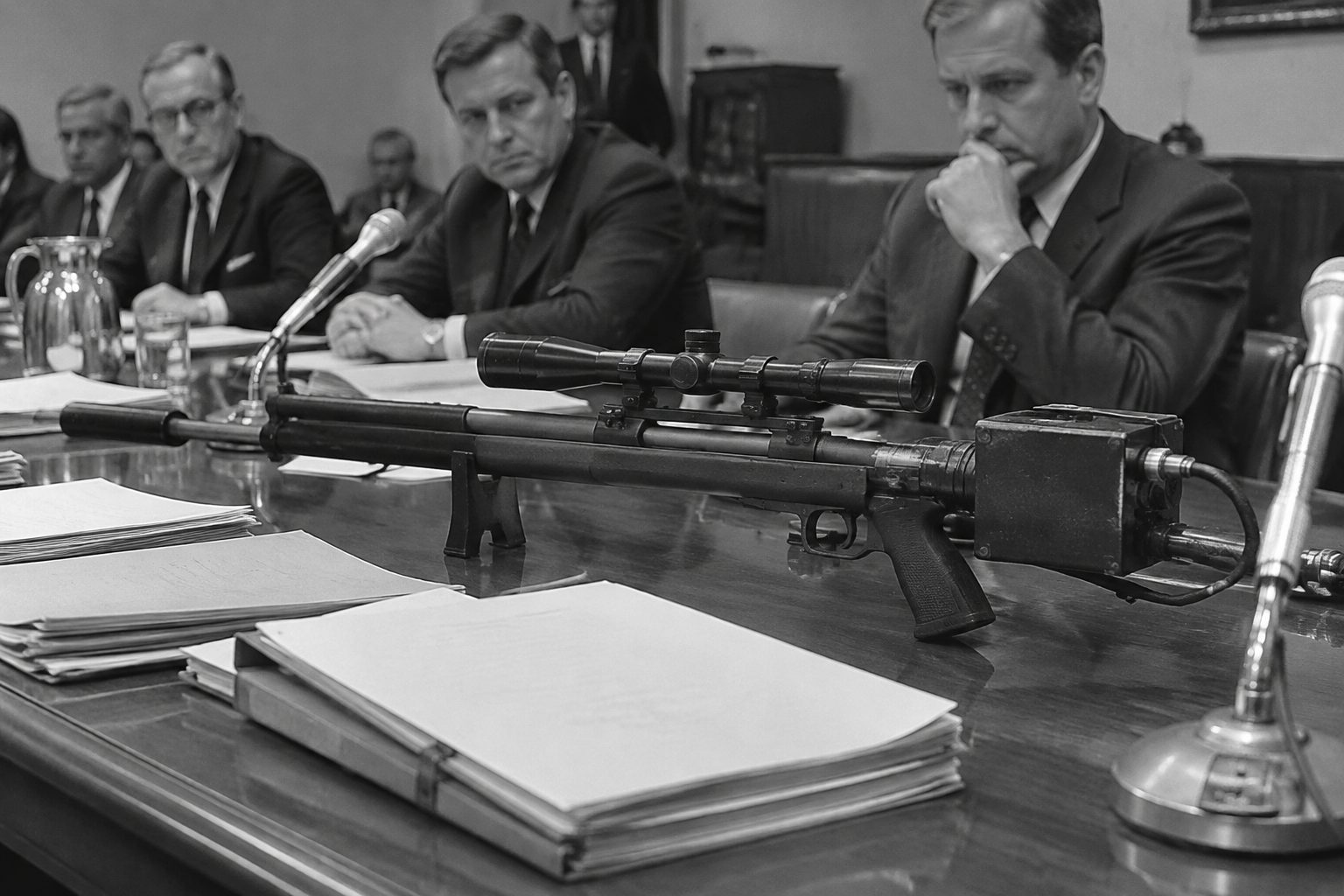
In September 1975, the Church Committee unveiled a bespoke CIA dart gun firing deadly toxins. Declassified records reveal what the weapon was truly engineered to do—and where the mythology begins.
25 October 2026 · InMillhouse
On 16 September 1975, during a televised hearing of the Senate Select Committee to Study Governmental Operations with Respect to Intelligence Activities, Senator Frank Church lifted a bizarrely modified handgun before the cameras [1]. Equipped with an oversized telescopic sight, a widened barrel, and a battery-powered firing system, the weapon instantly entered modern conspiracy folklore. Popular mythology soon christened it the CIA's 'heart attack gun'—an undetectable instrument rumoured to have culled dissidents and foreign leaders across the globe by simulating natural cardiac arrests.
Declassified hearings and Agency memoranda paint a picture that is both more mundane and considerably more alarming than popular legend suggests [1, 2]. The weapon was real, engineered under the auspices of Project MKNAOMI—a joint venture between the CIA’s Special Operations Division and the US Army Biological Laboratories at Fort Detrick, Maryland [2]. Rather than an off-the-shelf assassin’s sidearm, the pistol was an experimental delivery system: a heavily adapted Colt .45 designed to project a 0.25-millimetre micro-dart, or a frozen flechette of biological toxin, across distances of up to 100 metres with almost negligible sound [1].
The medical realities, however, diverge sharply from the claim of simulated myocardial infarctions. The primary payload tested for the device was saxitoxin, an exceptionally lethal marine neurotoxin extracted from Alaskan butter clams [2, 3]. Saxitoxin does not induce a heart attack in the clinical sense. Instead, it inhibits nerve impulse transmission, causing rapid motor paralysis, respiratory collapse, and fatal asphyxiation, which subsequently halts the heart [3]. Because the frozen delivery projectile dissolved inside the target, leaving only a microscopic red puncture akin to a mosquito bite, post-mortem toxicological detection was virtually impossible with 1970s forensic methodology [1, 2].
Yet the most critical discovery of the Church Committee was institutional insubordination rather than clandestine homicide [1]. In November 1969, President Richard Nixon had issued a categorical directive ordering the unilateral renunciation and destruction of all American offensive biological and toxin weapon stockpiles. Five years later, the Church Committee discovered that CIA technical staff had deliberately defied presidential orders, secreting away 11 grams of saxitoxin and several milligrams of cobra venom inside a vaulted storage facility [1, 3].
CIA Director William Colby testified under oath that the dart apparatus had remained strictly experimental and was never deployed for an operational assassination [1]. While sceptics frequently reject this assurance, the declassified historical record establishes that MKNAOMI’s firearm was not a weapon of mass deployment, but a lethal laboratory prototype that survived entirely through bureaucratic defiance [1, 3].